

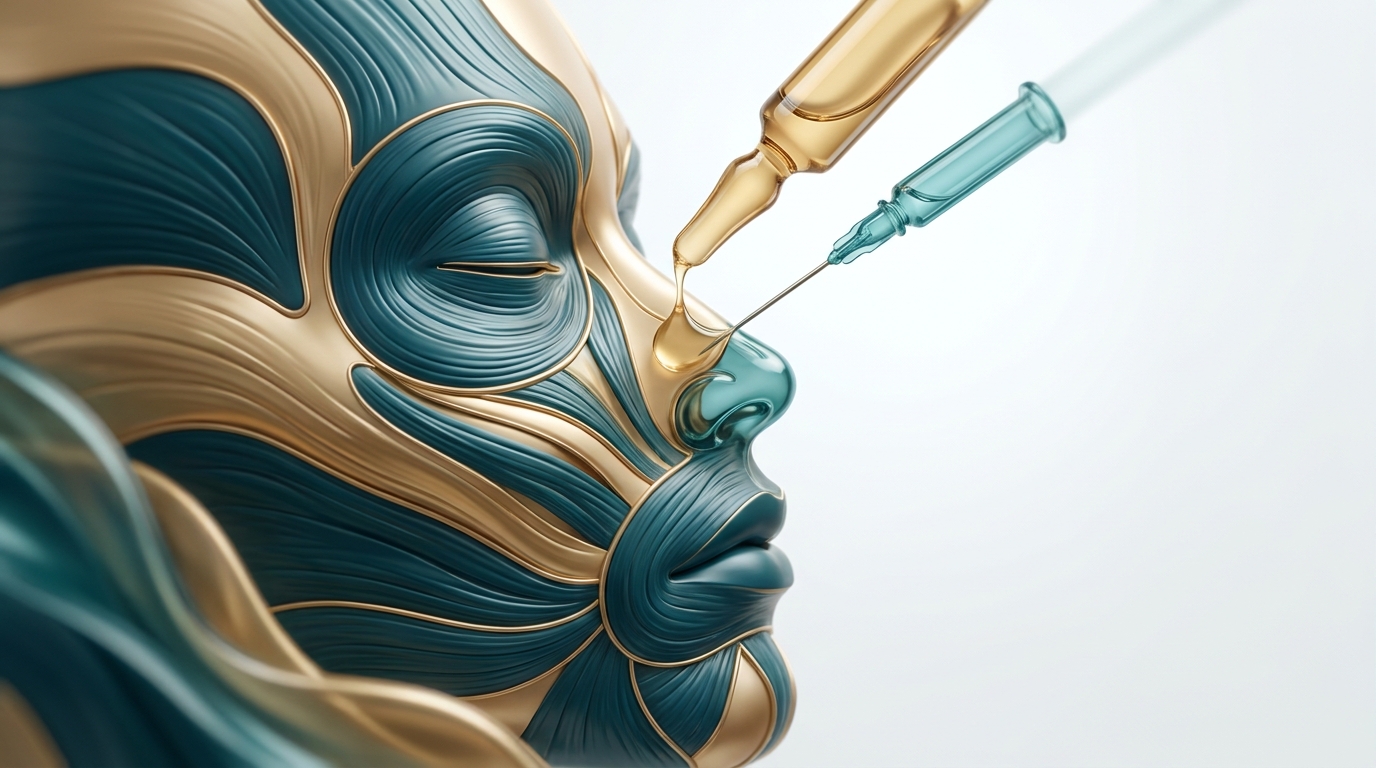
What are expression lines?
Expression lines develop through the repeated movement of the facial muscles. Every smile, every furrowing of the brow and every squinting of the eyes activates small muscles directly beneath the skin. In younger years, the skin smooths out completely after each movement. With increasing age, however, it loses elasticity because the production of collagen and elastin decreases. As a result, the lines that were previously visible only briefly become permanently noticeable.
Typical expression lines in the upper third of the face are:
- Forehead lines: horizontal lines that appear when the eyebrows are raised.
- Frown lines (glabellar lines): vertical lines between the eyebrows, often referred to as "thinker's lines".
- Crow's feet: fine, fan-shaped lines at the corners of the eyes that become visible when laughing or squinting.
Why do expression lines develop?
The development of expression lines results from the interplay of several factors. In addition to individual facial expressions, genetic predisposition, lifestyle and environmental influences also play a role.
Important influencing factors
- Skin ageing: Over the years, collagen fibres, elastin and hyaluronic acid in the skin decrease.
- UV radiation: Sunlight accelerates the breakdown of collagen and promotes so-called photoageing.
- Smoking: Nicotine impairs skin circulation and supports the formation of wrinkles.
- Lack of sleep and stress: Can affect the complexion and reinforce expression patterns.
- Genetics: Skin type, tendency to wrinkle and facial expressions are partly hereditary.
Expression lines are therefore not a sign of illness, but a natural part of life. Some people, however, find them distressing – particularly when frown lines convey a tired or annoyed facial expression that does not match the person's inner mood.
How does botulinum toxin type A work?
Botulinum toxin type A is a protein produced by a bacterium. In very small, purified doses, it has been used in medicine for decades – originally for the treatment of muscle spasms and neurological disorders, and later also in aesthetic medicine.
The substance temporarily blocks the transmission of nerve signals to the muscle. The treated muscle then relaxes. The overlying skin is less strongly creased, and existing lines can smooth out. The effect usually sets in within a few days and generally lasts three to six months. The body then breaks the substance down completely.
When can treatment be useful?
Whether treatment with botulinum toxin is appropriate is an individual decision. It should always be based on a detailed medical consultation and examination.
Possible areas of application in the upper face
- Forehead lines with botulinum toxin: When horizontal forehead lines remain visible even at rest.
- Treating frown lines: When the vertical lines between the eyebrows create an annoyed or tense facial expression.
- Crow's feet: When the lines at the corners of the eyes are perceived as bothersome.
In addition, botulinum toxin type A is also used in medicine outside the aesthetic field, for example for chronic migraine, excessive sweating (hyperhidrosis) or certain muscular tensions. These applications each follow their own medical criteria.
Prerequisites for treatment
Treatment may be considered if:
- the expression lines are perceived as distressing,
- there are realistic expectations regarding the result,
- there is no pregnancy or breastfeeding,
- there are no neuromuscular disorders or acute skin infections in the treatment area,
- there are no known hypersensitivities to the substance.
How a treatment proceeds
Every treatment is preceded by a detailed consultation. Wishes, medical history, possible risks and alternatives are discussed.
Typical procedure
1. History and consultation: Clarification of the individual situation.
2. Analysis of facial expressions: Assessment of muscle activity and skin condition.
3. Treatment: Using fine needles, small amounts of the substance are precisely introduced into the affected muscle areas. The treatment usually only takes a few minutes.
4. Aftercare instructions: After the treatment, sport, sauna and intense heat should be avoided for a few hours.
5. Follow-up appointment: After about two weeks, the result can be assessed and, if necessary, fine-tuned.
Possible side effects and limitations
Like any medical measure, treatment with botulinum toxin can also have side effects. These are often mild and temporary:
- mild redness, swelling or small bruises at the injection sites,
- headaches or a feeling of pressure in the first few days,
- rarely a temporary drooping of an eyebrow or eyelid.
Botulinum toxin only smooths lines caused by muscle activity. Lines that are due to volume loss or marked skin ageing cannot be corrected with it. In such cases, other methods – such as professional skin care, medical laser therapies or volume treatments – may be considered as a supplement.
What botulinum toxin cannot achieve
Treatment with botulinum toxin is not a fountain of youth and no substitute for a healthy lifestyle. Factors such as sufficient sleep, a balanced diet, sun protection and avoiding nicotine have a significant long-term impact on the complexion. An aesthetic treatment can have a supportive effect but does not replace careful skin care or a responsible approach to one's own body.
Conclusion
Expression lines are a natural reflection of our lives and our personality. If they are perceived as distressing, treatment with botulinum toxin type A in the upper third of the face – for example for forehead lines, frown lines or crow's feet – can be an option. What is decisive is a careful medical consultation, realistic expectations and an individually tailored approach. In this way, a natural, rested appearance can be supported without losing one's personal facial expression.
This article does not replace medical advice.